Randy, On the Record
If Chatham-Kent Lost 500 Jobs, Where Are the Facts?
- Issued by
- Randy Hope campaign
- Published
The key themes, at a glance
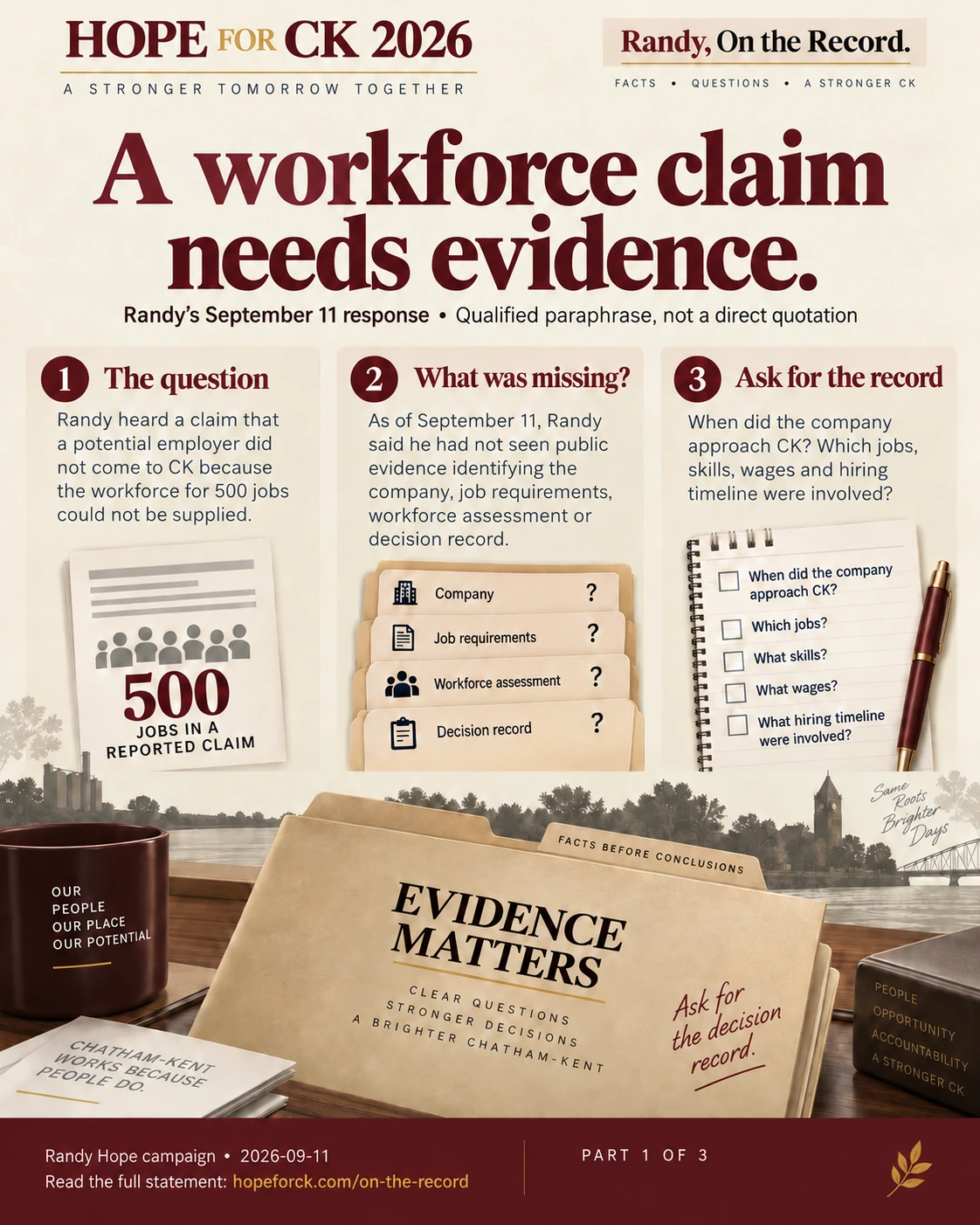
A workforce claim needs evidence.
Part 1 of 3 · Download image
Text summary
Randy’s September 11 response • Qualified paraphrase, not a direct quotation
The question
Randy heard a claim that a potential employer did not come to CK because the workforce for 500 jobs could not be supplied.
What was missing?
As of September 11, Randy said he had not seen public evidence identifying the company, job requirements, workforce assessment or decision record.
Ask for the record
When did the company approach CK? Which jobs, skills, wages and hiring timeline were involved?
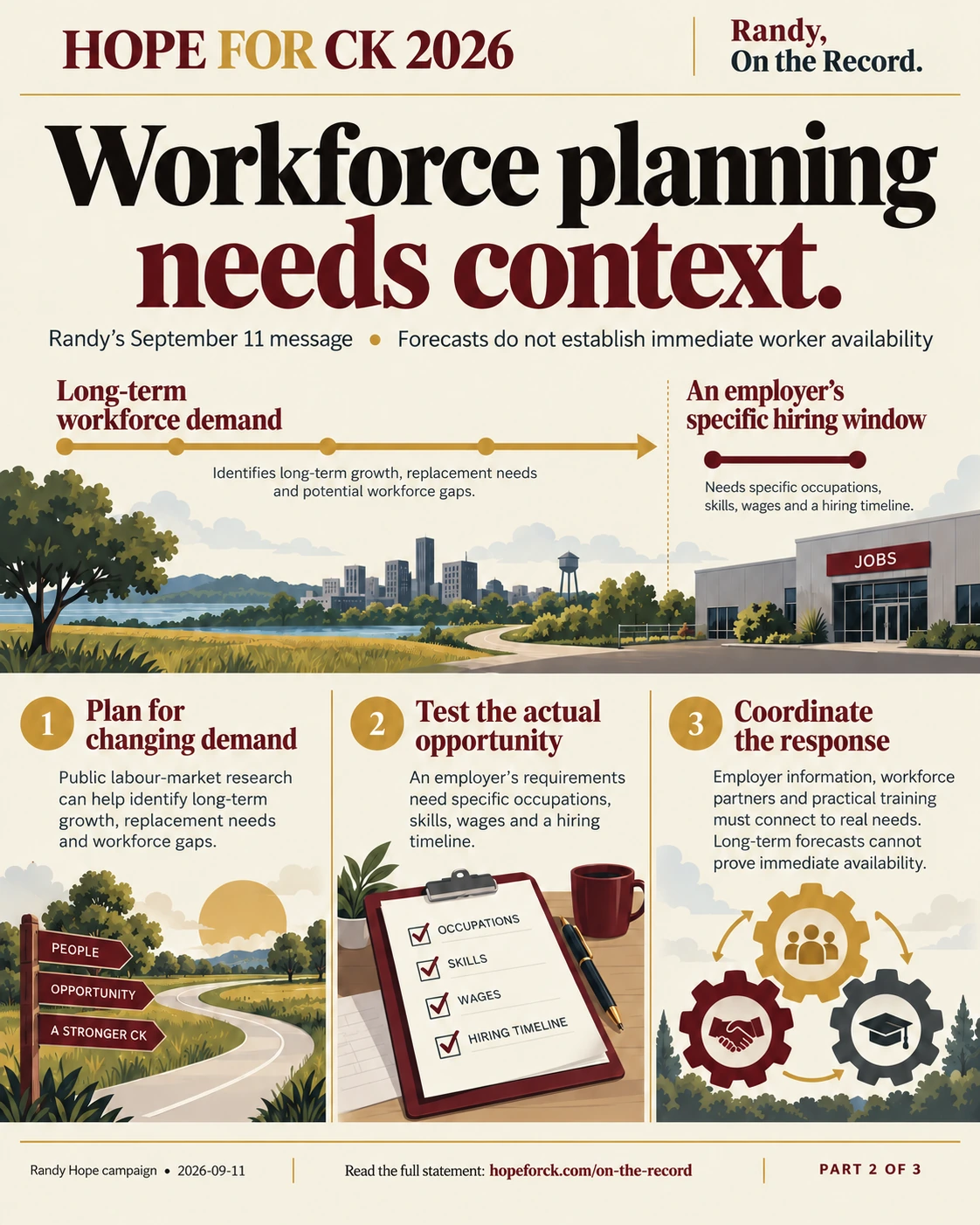
Workforce planning needs context.
Part 2 of 3 · Download image
Text summary
Randy’s September 11 message • Forecasts do not establish immediate worker availability
Plan for changing demand
Public labour-market research can help identify long-term growth, replacement needs and workforce gaps.
Test the actual opportunity
An employer’s requirements need specific occupations, skills, wages and a hiring timeline.
Coordinate the response
Employer information, workforce partners and practical training must connect to real needs. Long-term forecasts cannot prove immediate availability.
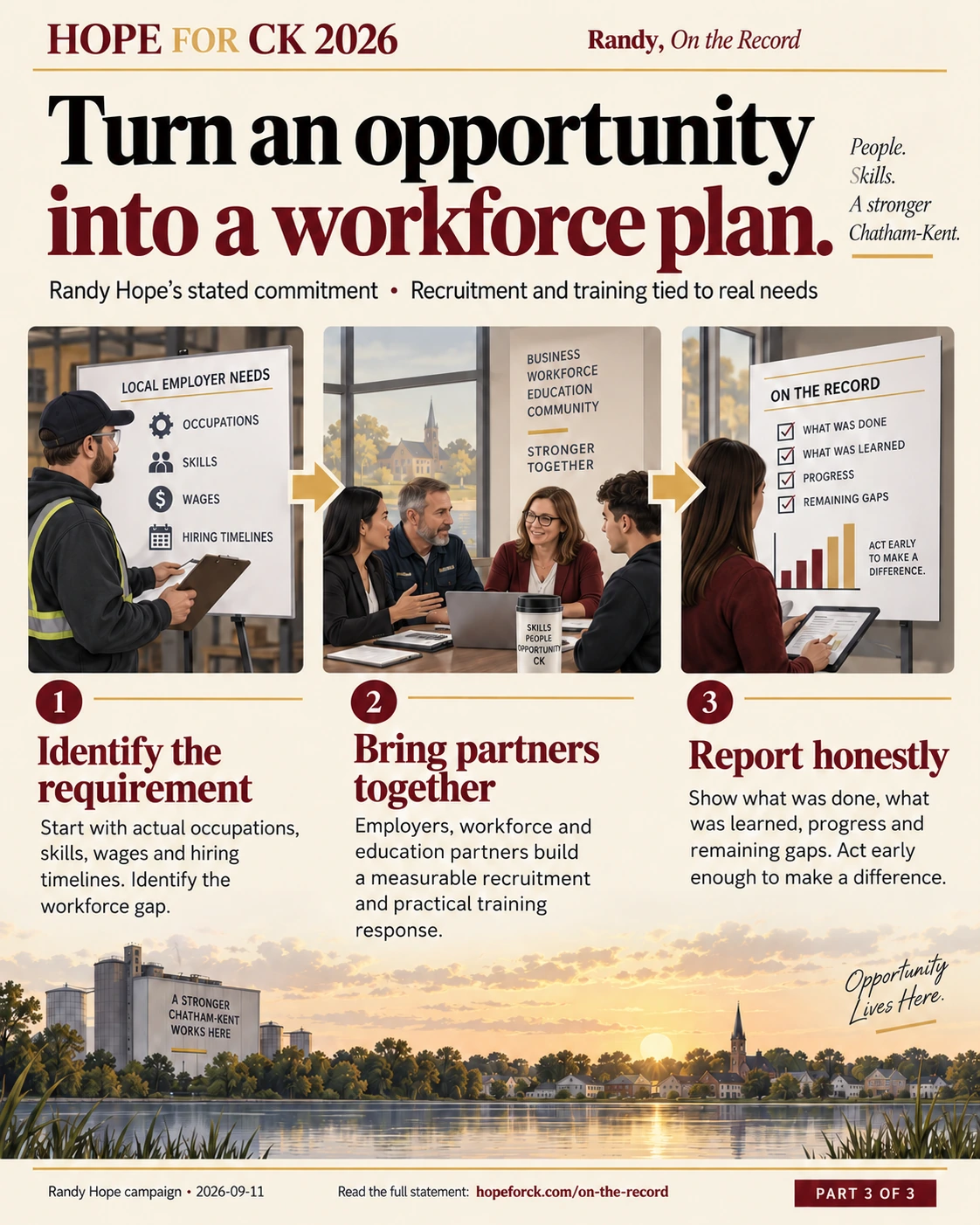
Turn an opportunity into a workforce plan.
Part 3 of 3 · Download image
Text summary
Randy Hope’s stated commitment • Recruitment and training tied to real needs
Identify the requirement
Start with actual occupations, skills, wages and hiring timelines. Identify the workforce gap.
Bring partners together
Employers, workforce and education partners build a measurable recruitment and practical training response.
Report honestly
Show what was done, what was learned, progress and remaining gaps. Act early enough to make a difference.
Media release
At Wednesday night's Chatham-Kent Growth Alliance candidate open house, Mayor Darrin Canniff made a statement to the effect that a potential large employer did not come to Chatham-Kent because our community could not supply the workforce for 500 jobs.
For clarity, I am not presenting those words as a direct quotation. They are a qualified paraphrase of the statement I heard at the event.
That is a serious claim. But no company was identified. No industry, occupations, wage range, hiring timeline, workforce assessment or decision record was provided. As of September 11, I have not seen public evidence that allows residents to test what happened.
If this was a real lost investment, the people of Chatham-Kent deserve a full account.
1. When did the company approach Chatham-Kent?
2. What jobs, skills, wages and hiring timeline were involved?
3. What evidence showed that those positions could not be filled?
4. Which local workforce and education partners were asked to help?
5. What did the municipality do before the opportunity was lost?
These are fair questions for any mayor. They are especially relevant because Mayor Canniff is publicly listed as a member of the Chatham-Kent Workforce Planning Board.
The Board maintains public labour-market data and a continuing research program dealing with workforce gaps, barriers to employment and the talent pipeline.
Its 2025 Local Labour Market Plan projects 20,290 openings between 2025 and 2035, including 4,040 from growth and 16,250 from replacement demand. That projection does not prove that 500 suitable workers were immediately available to an unidentified company. It does prove that workforce readiness is a known, measurable public challenge that requires planning.
The Board-sponsored 2026 workforce report makes the same accountability point from another direction. It recommends gathering better information from employers, creating employer roundtables, building an education-employer forum and expanding practical, short-duration training tied to changing skill needs. Its relevance here is information-sharing and coordinated workforce action, not AI promotion.
That is what leadership should look like: get the facts, identify the need, bring the right partners together and act early enough to make a difference.
This is not about pretending that every employer can hire 500 qualified people tomorrow. A responsible response begins with the actual occupations, skills, wages and timeline. It connects recruitment and training to a real opportunity, measures progress and deals honestly with any remaining gap.
It is also not acceptable to leave the people of Chatham-Kent with the impression that they are simply unqualified, or that our community is incapable of competing for major investment. Our workers deserve facts, opportunity and leadership - not an unsupported conclusion about what they cannot do.
If a 500-job opportunity was lost, show Chatham-Kent the evidence. Then show us what was learned, what was done and how it will be prevented from happening again.
My commitment is straightforward: when an employer brings an opportunity, we will identify what it requires, put the right partners at the table, build a measurable recruitment and training response, and report honestly on the result.
— Randy Hope
Sources and context
- Chatham-Kent Growth Alliance: September 9, 2026 Municipal Candidate Open House (event and format only)
- Chatham-Kent Workforce Planning Board: Meet the Board
- Chatham-Kent Workforce Planning Board: Labour Market Data
- Chatham-Kent Workforce Planning Board: Workforce Gaps Research
- Chatham-Kent Workforce Planning Board: 2025 Local Labour Market Plan, pp. 65-66
- Chatham-Kent Workforce Planning Board: Artificial Intelligence and the Workforce — The Case of Chatham-Kent, March 2026