Randy, On the Record
Let’s Talk About the Record.
- Issued by
- Randy Hope campaign
- Published
The key themes, at a glance
Let’s Talk About the Record.
Text summary
Randy Hope campaign statement summary · Source-linked historical results
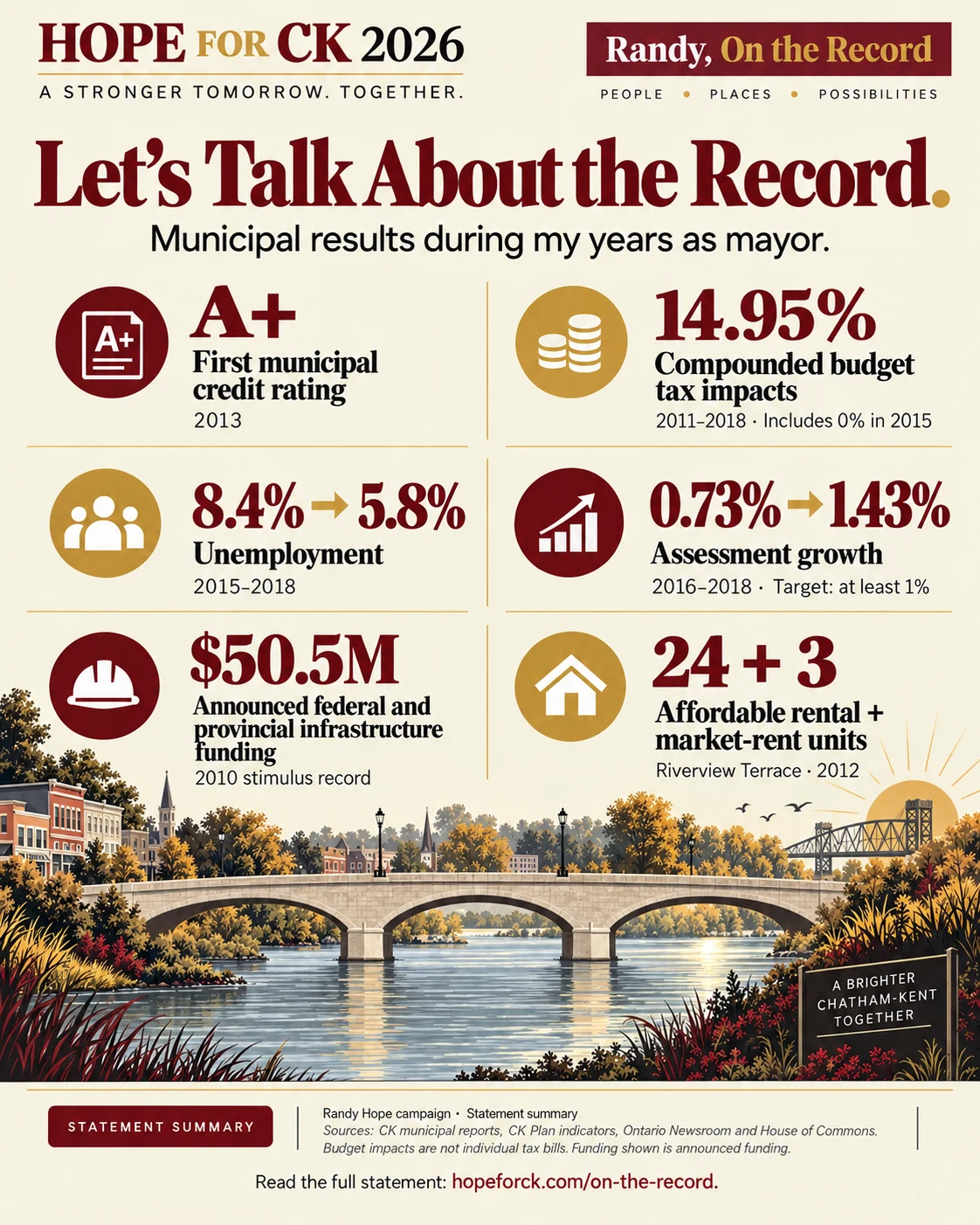
A+ credit rating
First municipal rating, 2013.
Budget tax impacts
14.95% compounded, 2011–2018; includes 0% in 2015.
Unemployment
8.4% to 5.8%, 2015–2018.
Assessment growth
0.73% to 1.43%, 2016–2018.
Infrastructure funding
$50.5 million in announced federal and provincial funding.
Riverview Terrace
24 affordable rental and three market-rent units, 2012.
Media release
Fellow residents,
I want to set the record straight.
I’m listening to your comments and the questions you’re raising about taxes, spending, roads and jobs. These things matter because they affect your household, your business and the community you call home.
You deserve answers. And when you ask about my years as mayor, I want to give you something concrete to judge.
I served as mayor for twelve years. Leading a municipality means making difficult choices and keeping people focused on the work, even when the pressures are coming from several directions.
Let me walk you through the record.
Start with the finances.
Chatham-Kent’s 2017 Annual Report recorded municipal debt falling from approximately $162 million in 2010 to $86 million by January 2017. At the end of 2018, audited statements recorded $76.73 million in net long-term liabilities.
In 2013, we earned the first A+ credit rating in Chatham-Kent’s municipal history.
That financial direction mattered. We had obligations to meet, services to maintain and taxpayers to consider. As mayor, I had to help keep those priorities together through each budget and each decision.
Then look at taxes.
I understand your concerns. You want to know whether the municipality is managing its costs and whether you can afford what comes next.
Across the eight budgets from 2011 to 2018, the approved annual tax impacts compounded to approximately 14.95%. In 2015, the approved increase was zero.
That compounded figure describes the annual budget impacts. Across the eight budgets from 2019 to 2026, the municipality’s published annual increases compound to 35.37%—more than double the earlier eight-budget figure.
The 2017 Annual Report also recorded the second-lowest detached-bungalow residential taxes among 28 participating municipalities with populations above 100,000. Our industrial tax rate ranked 15th-lowest among 102 participating Ontario municipalities.
Those are specific comparisons, and I want to be clear about what they measure. Because they give residents a benchmark for assessing the decisions Council and I made during those years.
My responsibility was to keep affordability in the discussion while making sure the municipality could do its work. We achieved that.
Infrastructure was part of that work.
When you ask about roads, bridges, sewers and water treatment, you’re asking about things people depend on every day.
During the stimulus period, federal and provincial announcements totalled $50.5 million in funding for Chatham-Kent infrastructure projects, including roads, bridges, municipal buildings, sewers and water-treatment facilities.
That figure is announced funding. It is not a claim that every infrastructure need was resolved.
But it belongs in the record. Leading a municipality means keeping those needs on the table and working beyond the municipal budget to bring resources into the community.
Today, Chatham-Kent’s July 2026 asset-management report estimates an infrastructure funding gap of approximately $2.663 billion over ten years.
The financial story connects to real jobs.
People need an opportunity to earn a living here.
Chatham-Kent’s recorded unemployment rate fell from 8.4% in 2015 to 5.8% in 2018. Median after-tax household income also rose from $44,460 in 2013 to $50,570 in 2018.
Over the final three years of my term, assessment growth also rose from 0.73% to 1.43%, exceeding the municipality’s target of at least 1%. That measure represents new municipal taxes generated through property development. It measures development-related tax revenue, rather than population growth alone.
These results show improving conditions across our entire community. As mayor, my job was to keep jobs, find investments and keep development moving through the municipal agenda. We achieved that.
One concrete example was Gateway’s proposed Cascades investment: $36 million and up to 200 jobs, subject to approvals. The company’s announcement specifically recognized my cooperation, alongside Council and staff, in helping the project advance.
A mayor has to bring people together, work through the decisions and keep an opportunity moving.
That same leadership has to reach real people who need real support.
During my time as mayor, Riverview Terrace opened with 24 affordable rental units for low-income seniors and people with disabilities, plus three market-rent units.
Council also approved a $1.5-million hospice leadership grant, matched by community donations.
Housing and hospice care belong in this story because municipal decisions affect people at very personal moments in their lives.
What’s important is that the work reaches the people that call our community home.
I’m proud of this record. I led the municipality during those years, and I stand behind the direction we took and the decisions I helped make.
Experience matters. So does the record. When you can take what you learned and apply it to the challenges in front of you, I see opportunities for Chatham-Kent.
So keep asking the questions—about taxes, spending, infrastructure and jobs.
Look at the record. Read my plans. Judge whether my approach is practical and whether the results can be measured.
That is the conversation I want to have with you.
— Randy Hope
Sources and context
- Municipality of Chatham-Kent: 2017 Annual Report
- Municipality of Chatham-Kent: 2018 Audited Financial Statements
- Municipality of Chatham-Kent: Financial Reporting Policy
- Chatham Voice: 2011–2014 approved tax impacts
- Municipality of Chatham-Kent: 2015 Annual Report
- Chatham Voice: 2016 approved budget
- Municipality of Chatham-Kent: 2018 Tax Policy
- CK Plan 2035: Unemployment
- CK Plan 2035: Median Household Income
- CK Plan 2035: Assessment Growth
- Gateway: Cascades Chatham investment announcement
- Ontario Newsroom: Riverview Terrace opening
- Chatham Voice: Council approves hospice grant
- Chatham-Kent Hospice: Summer 2016 newsletter
- House of Commons Debates: Chatham-Kent infrastructure funding
- Municipal candidate Q&A: 2017–2026 annual tax series
- July 13, 2026 consolidated asset-management report