Randy, On the Record
Your Vote. Your Choice. Make It an Informed One.
- Issued by
- Randy Hope campaign
- Published
The key themes, at a glance
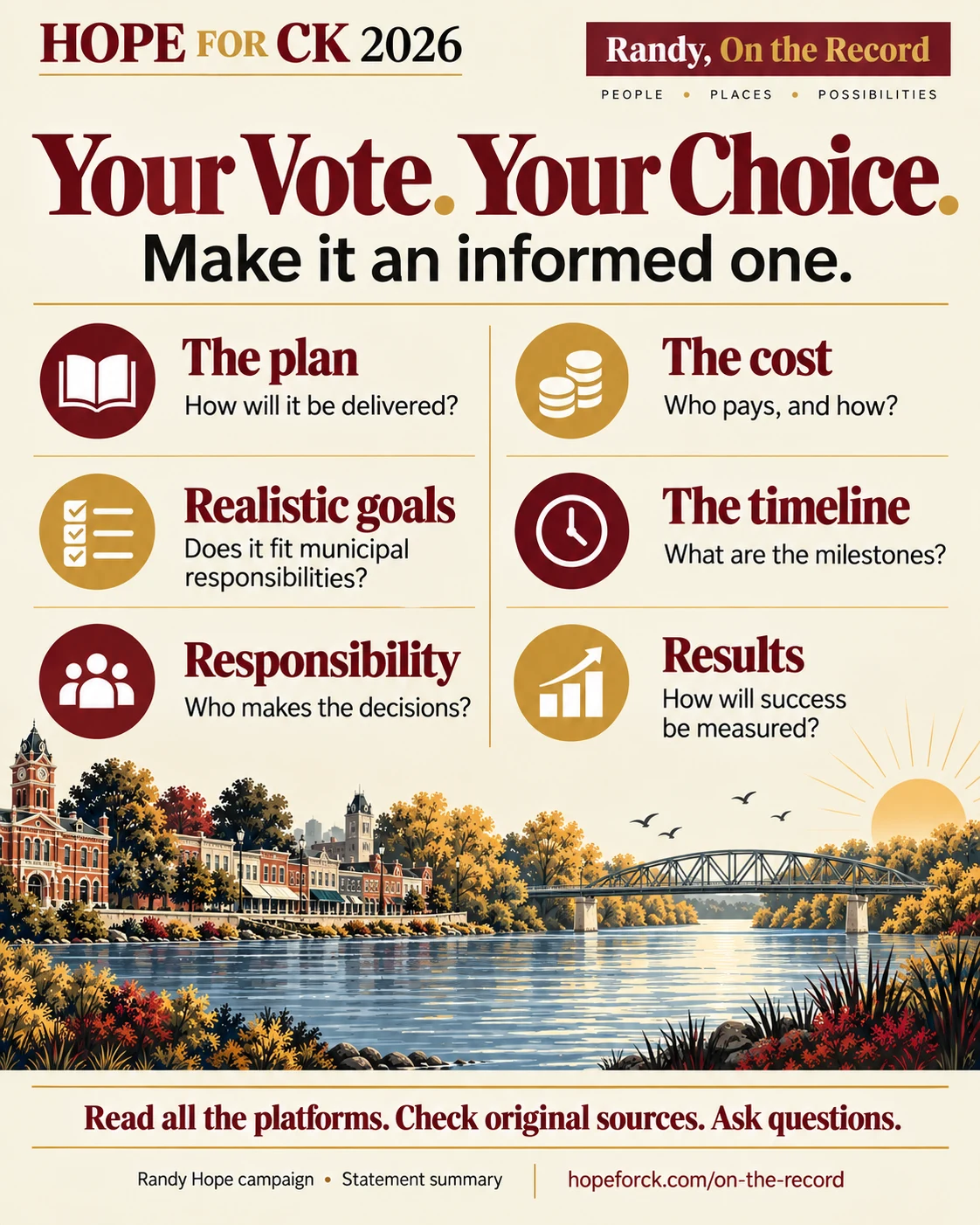
Your Vote. Your Choice.
Text summary
Randy Hope campaign statement summary
The plan
How will it be delivered?
The cost
Who pays, and how?
Realistic goals
Does it fit municipal responsibilities?
The timeline
What are the milestones?
Responsibility
Who makes the decisions?
Results
How will success be measured?
Media release
Fellow Residents,
On October 8, online voting begins in Chatham-Kent's municipal election.
Before you cast your ballot, I want to encourage every voter to take the time to look at what all the candidates are proposing for the future of our municipality.
Don't just look at the signs. Don't just read the slogans. Take the time to understand the plans behind them.
Visit the candidates' websites. Read their platforms. Look at their public statements, interviews and answers to questions. Watch the all-candidates debates and consider what was said, what wasn't answered and what you still want to know.
Most importantly, think critically about what you're being told.
Look beyond the promises
It's easy for any candidate to say they want lower taxes, better roads, more jobs, improved services and a stronger local economy. I think most of us can agree those are worthwhile goals.
The important questions are how we get there, what it will cost and whether the proposed approach is realistic.
When you read a platform, ask yourself:
• What's the actual plan? Does the candidate explain how they intend to achieve what they're promising?
• What will it cost? Are there estimates, funding sources and an explanation of how taxpayers will be affected?
• What's realistic? Does the proposal account for the municipality's financial position, responsibilities and limitations?
• What's the timeline? Are there clear milestones and a way to measure progress?
• Who is responsible? Does the candidate understand the role of the mayor, Council, municipal administration and other levels of government?
• How will success be measured? Will residents be able to see whether the promise was delivered?
Not every issue has a simple answer, and not every campaign can provide every detail before an election. But there is a difference between identifying a problem and explaining a credible path toward solving it.
Do your own research
Don't rely on a single Facebook post, a campaign advertisement or something someone shares online to make your decision.
Read the original material where you can. Check the context behind claims. Compare what candidates say with publicly available information. If something is unclear, ask questions.
And remember that candidates can have different ideas about how to solve the same problem. You don't have to agree with everything any one person proposes. What matters is understanding those differences and deciding which approach best reflects your own priorities and expectations.
Your vote should be based on your judgment, not simply on who has the biggest signs, the most polished advertisements or the loudest voice.
Explore the mayoral candidates
The following list is alphabetical by surname. Visit the campaign websites and compare the candidates' plans:
• Nelson Burm — no campaign website was listed in the directory checked October 7. See the official municipal candidate registry.
• Ryan Gow
Think about the next four years
The person elected mayor will help lead Chatham-Kent through the next four years, alongside Council and municipal staff.
The decisions made during that time will affect our taxes, infrastructure, local businesses, housing, public services and the opportunities available to our families and communities.
These are important decisions. They deserve more than a quick glance at a campaign slogan.
I've put forward my own platform and explained my thinking through my website and my Randy, On the Record releases. I encourage you to read them, question them and compare them with what the other candidates are offering.
I want you to make an informed decision, even if that means you reach a different conclusion than I do.
Because at the end of the day, this election isn't about any one candidate. It's about the future of Chatham-Kent and the people who call it home.
Online voting opens October 8 at 10:00 a.m. and closes October 16 at 4:00 p.m. You can find official voting information through the Municipality of Chatham-Kent's election website.
Before you vote, do your homework. Ask questions. Read the platforms. Think critically. Make the choice that's right for you and your community.
Your Vote. Your Choice. Make it an informed one.
— Randy Hope